Julian Barkes, Bemco director and KNX UK board member, talks the Internet of Things, digital lighting and growing demand for home automation…
The Internet of Things, digital lighting and the growing demand for home automation, in general, provide the electrical contracting market with a fantastic opportunity to make up ground lost to the custom install world.
The traditional electrician can seize the initiative and become the go-to Smart Installer. Here’s how…
For too long the custom install market has had its pick of the high margin work. Now, as satellite and AV installations are displaced by IoT (Internet of Things) devices and an ever-expanding choice of new products and systems, the electrical contracting market has a fantastic opportunity to make up ground. The market has moved on from multi-room AV control. Today, a wider range of installer skill sets is required to deliver fully integrated lighting, heating and AV systems.
Key to delivering these solutions is a fundamental understanding of electricity and structured wiring. The electrician is ideally placed to become the ultimate smart installer – in other words, a Professional electrician, digital plumber and technology expert all rolled into one.
Opportunities
Smart homes are big business: the spend on home automation, security and assisted living solutions, estimated at GBP£800 million in the UK in 2018, is growing exponentially and is expected to grow at just under 30% annually until 2021: and even then it will only have reached 40% of homes. (Source: Statista.com). This is a long-term opportunity and one worth investing in to upskill and claim your share of the rewards.
Cabling infrastructure
Cabling is the backbone. A structured wiring scheme allows the smart installer to bring technology everywhere in the home, without having to trail additional wires every time a new device is introduced. Get the infrastructure right, and achieving uninterrupted broadband is perfectly possible.
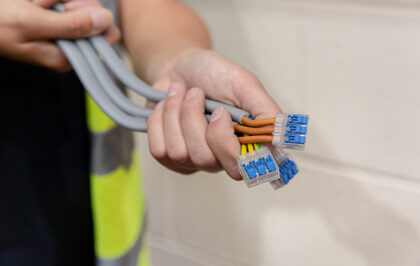
A structured wiring scheme allows the smart installer to bring technology everywhere in the home. You can even get standalone devices (eg. Nest, Alexa, Sonos), using KNX, to communicate with each other. The KNX cable (green) is a twisted-pair bus cable which enables any device that is daisy-chained to it to be controlled.
Running and installing the cable is bread-and-butter work for an electrician. Designing a project plan and using the ETS software to programme the devices is more complicated, but easily manageable within the electrician’s skillset.
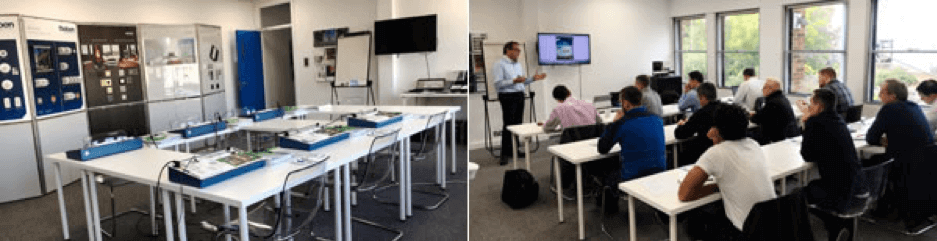
To become an approved KNX installer you need to complete the Certified KNX Training Partner course. It is a very structured course and takes people from all levels of experience to the same stage at the end. An electrician’s fundamental understanding of electricity, however, is a major advantage.
There are a number of reasons why the electrician is in an ideal position to become a smart installer.
Electricians are used to pulling and terminating cables.
Electricians are NICEIC registered and insured, with a critical understanding of electrical installations.
Electricians are familiar with circuitry and LED dimming challenges. Lighting control is at the core of home automation.
Most electricians have had good exposure to other Trade services such as plumbing, security, AV, and are in a far stronger position than a Custom Installer to steer projects and maximise co-operation.
Most electricians have experience of working in or running their own small business, assessing and specifying jobs, and winning projects.
Crucially, electricians have relationships with existing customers and are likely to have built up a database, so already have a foot in the door.
Becoming a smart installer
Good ‘sparks’ are in huge demand, but in short supply – most trades would kill for this imbalance.
The same imbalance exists in the smart home market, except most homeowners and business owners don’t know even where to go, or who to ask, to make their homes/offices smarter. The opportunity that exists is the equivalent of an open goal, and the electrician can be the match winner!
To date, the home automation market has focused on ultra high-end customers, which account for perhaps 10% of the market, whereas the real opportunity exists in the much larger middle section (80%). Home automation is now an affordable reality for them, and as prices continue to come down, the market will speed up.
Seizing the opportunity
For the electrician looking to develop their business, my advice is to get involved with home automation. You can increase the value of projects and take advantage of upselling opportunities, significantly increasing your profit earning potential. You can spend less time pulling cables and more time planning installations, programming them and managing them.
Obviously if you are increasing your skillset and becoming an expert, you have to soak up a lot of information, There are no shortcuts, so get tuned-in to the latest innovations and market developments. Identify your knowledge gaps, be they in networking, heating or security, and train accordingly.
Become an expert in a system such as KNX, that is open, flexible and scalable and doesn’t lock your customer – or you – into one manufacturer. There are certified training courses throughout the UK and the UK’s association of KNX manufacturers, integrators and wholesalers will help you find courses and, perhaps just as important, other like-minded installers to chew the fat with.
Certified KNX training courses are available to help electricians expand their skillsets.


 For too long the custom install market has had its pick of the high margin work. Now, as satellite and AV installations are displaced by IoT (Internet of Things) devices and an ever-expanding choice of new products and systems, the electrical contracting market has a fantastic opportunity to make up ground. The market has moved on from multi-room AV control. Today, a wider range of installer skill sets is required to deliver fully integrated lighting, heating and AV systems.