Luke Wichard runs his My Trusted Electrician business around Greater London. In our latest blog, he reflects on making assumptions when he was training.
“Assumption is the mother of all mess-ups”.
Many moons ago, when I was going through my training, I heard this phrase a lot.
It was made quite clear to me that if and when I made a mistake, I mustn’t start my excuse with, “but, I thought”.
Looking back at it now, it was quite funny, but at the time it was often a huge embarrassment.
Sometimes I would automatically fight my corner with the phrase, “but, I thought” and in unison, the whole building site would shout back: “We don’t pay you to think. We pay you to know!”
If you treat every task you carry out with this perspective, you will rarely go wrong – and if you do, your argument won’t start with, “but I thought”.
Manufacturer’s instructions (MIs), most people don’t read them. It’s like a bloke admitting that he’s lost and asking for directions.
I’ll hold my hands up and admit that once upon a time I used to be exactly the same.
You can’t help but feel that if you’ve installed one electrical fixture/appliance then you’ve installed them all. But one stupid mistake later…
One sentence that started with, “but, I thought” and I automatically knew how daft I was for not reading the MI. Now I’m going to try and convince you to do the same.
Look at these photos below.
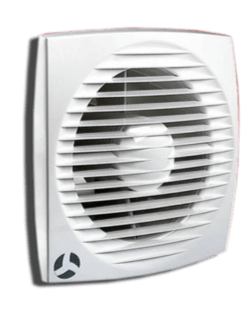
Manrose NVF100T
Manrose XF100T
Airflow Aura Eco Air
These are what I would consider as the most common brands of 230V timer fans.
I think everyone reading this blog will come across at least one of these extractor fans in their career.
Now ask yourself the question, “did I just plonk this on the 6 amp lighting circuit?”
Of course, you did. It’s a timer fan.
It wouldn’t work if it wasn’t on the lighting circuit.
Now I’m going to show you a paragraph from each of these extractor fans MIs.
Manrose NVF100T
Wiring of Standard Model – Diagram 2
This fan can be either operated from a suitable remote switch or a separate pullcord switch fitted to the ceiling of the room or can be connected to the light switch so that the fan will start when the light is switched on. The cable from the fan must be connected to a double pole fused spur having a contact separation of at least 3mm in all poles, it must be used and fitted with a 3 amp fuse, and should be sited outside any room containing a shower or fixed bath. The fan should not be accessible to a person using either the shower or the bath.
Manrose XF100T
(iii) A double pole fused spur having a contact separation of at least 3mm in all poles MUST be used and fitted with a 3 amp fuse, and must be sited outside any room containing a shower or fixed bath. The fan must not be accessible to a person using either the shower or bath. Fan to be fitted a minimum of 1.8 metres from floor. When fitting through an external wall, an external grille must be fitted at all times.
Airflow Aura Eco Air
SAFETY REQUIREMENTS
The fan “Aura-eco” complies with the requirements according to the EU norms and directives. Level of protection from access to hazardous parts and waterproof is to IPX4 Connection of fans supplied with the electric cords to power supply as well as replacement of electric cord should be perfomed by a competent person (Part P) and in accordance with latest IEE wiring regulations. A 3 amp fused isolator should be fitted.
I can safely say that I don’t think I have EVER seen a 3 amp fused spur supplying an extractor fan whilst carrying out an Electrical Installation Condition Report on a domestic property. I have also never seen anyone else code an extractor fan in their observations. “But, I thought” springs to mind.
Along with extractor fans I’ve seen a variety of “but, I thoughts”.
Pre-flexed, 3.5Kw electric ovens wired onto a 32 amp BS60898/61009 MCB. I can see the logic behind why this has happened. 3.5Kw is too excessive for a 13 amp plug top or fused spur and so the electrician has just plonked the oven onto the existing 32 amp, 6mm Twin & CPC, Cooker circuit. They most likely hoped that the oven has some form of internal overload protection.
Electric ovens and Induction hobs wired in 6mm, Twin and CPC cable. The MIs however, have clearly asked for a 4mm Butyl flex to be used.
Mismatched MCB’s in a consumer unit. An electrician has come and installed an additional electrical circuit and has just used whatever MCB they’ve had on their van at the time. They obviously live in a Cinderella ‘If the shoe fits’ fairytale. I installed a Hager consumer unit a day prior to writing this blog. The manufacturer’s instructions have a small paragraph which states that only equipment from their Hager catalogue is to be used in their Consumer Units.
Only equipment and arrangements specified in Hager’s technical documentation / catalogue shall be used.
I hope that this short blog may have opened your eyes to a few of the most common “But, I thoughts” in the domestic electrical industry.