

Three Top Tips for Building Your Professional Social Media Presence
Three Top Tips for Building Your Professional Social Media Presence: Showcase your skills, grow your network and get noticed!
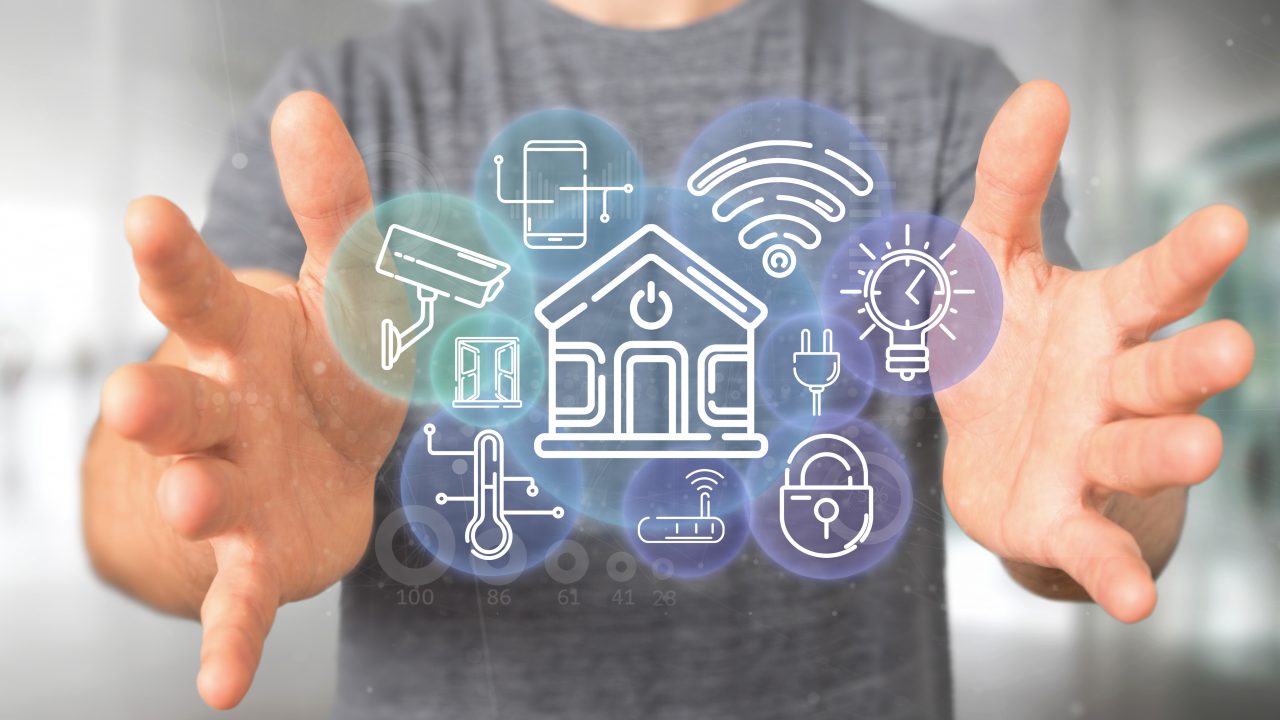
As the technology has evolved the goal of a smart home has shifted to minimising the quantity of gadgets and systems and integrating them to improve overall experience and efficiency.
Today, the smart home of the future will enable owners to:
1. Take control and minimise their impact on the environment and their pocket
2. Make their environment more comfortable by managing their surroundings
3. Personalise the home experience according to time of day, activities, or mood
4. Future proof their homes
So, what does all this mean and how can we simply achieve a smart home that’s fit for the future?
Smart homes not only enable us to choose our own environments, they also help us to understand and make choices about our impact on the wider environment: we can see how much energy we are using and we can reduce waste by switching things off when we don’t need them, or setting them to use energy when it is cheapest or to respond to the climate and season.
Schneider Electric’s Wiser smart heating solution gives control from your fingertips through your smartphone, or via voice assistant. Each room can be heated individually to keep cots cosy and kitchens cool.
The Wiser plug allows appliances to be turned off whenever you want, wherever you are in the world. This both allows control of resource use and reduces the anxiety of accidentally leaving anything switched on.
Having influence over the environmental quality of an office has long been seen as a key determinant of workplace satisfaction.
Much of the same is true at home, where we all have different needs and sensory requirements, be that for lighting, temperature, or sound. Being able to understand levels and adapt them to personal or family needs creates a home that will fit you like a glove.
That control could be boosting temperatures during a cold snap or improving air quality by monitoring CO2 levels and controlling air purifiers to filter toxins away. Understanding data from the environment around you allows you to control and set comfort levels more readily.
One of the best loved aspects of smart homes is their creativity; how they give people the ability to personalise their homes and better support the people inside. This could be as simple as choosing room-by-room specific sensory finishes, or the ability to create room ‘scenes’.
These configurations of settings can be used to create different types of ambiance within the same spaces, making each room adaptable and versatile and responsive to the household’s changing needs.
Our homes need to be more versatile now than ever before as we work, rest and play in the same spaces.
Each room may support a whole range of activities throughout the day and into the night. For example, good adaptable lighting is essential in the kitchen where the household may be preparing food, eating, working, and socialising. Plus, the pre-configured scenes can be programmed in advance so it can be set to ‘cooking with friends’ mode or ‘working from home’ mode to ensure the space really supports the activities at a touch of a button (or through voice activation when paired with Amazon Alexa or Google Assistant).
Similarly, the living room can be set to accommodate daytime activities with brighter lighting and shutters fully open, before switching to evening mode with heating turned up, lights dimmed and shutters closed.
Technology is always evolving, and predicting what the home of the future will actually contain remains elusively out of reach. So, adaptability is key to ensuring resilience and opening up opportunities.
Wiser helps to do just that, with a buildable system that allows users to add devices as the need arises. This means each household can choose what they want to prioritise as and when they can.
What’s more, the ability to control our environment using mobile phone apps means that it’s not a daunting prospect to learn how to use a whole new interface – we are already so familiar with our phones, one new app doesn’t take long to get used to.
The smart home of the future is already here, allowing us to manage our energy use and design surroundings to complement our lifestyle, enhancing family comfort and welfare. Far from being frightening or difficult, the user interfaces are ones we are mostly already familiar with.
As the world changes around us, so must our houses in order to adapt and improve the quality of our lives and the earth we live on.
Three Top Tips for Building Your Professional Social Media Presence: Showcase your skills, grow your network and get noticed!

SPARKS Competitions: Discover how entering could showcase your electrical skills, boost your confidence and open doors to new opportunities!

The prestigious SPARKS Learner of the Year competition is gearing up for its eighteenth year, alongside the inspiring SPARKS Female Skills Competition – and applications are now officially open!

Carhartt’s new women’s Steel Pants have been designed around how women actually move and work on site rather than simply resizing men’s.

We’re delighted to reveal that the SPARKS Learner of the Year 2026 is Samuel Stevely of HRUC Uxbridge!

Electrical distributor CEF has announced that registrations are now open for its latest TechTalks series, running from May to July 2026.